Best Bitcoin Mining Pools: Fees, Payout Methods, and a Practical Selection Framework
For an individual ASIC operator or mining farm, the best Bitcoin mining pool is the one whose reward method, fee basis, payout threshold, and operating controls fit its hardware and cash-flow needs. This comparison of the best Bitcoin mining pools uses documented BTC terms rather than unverified profitability claims. EMCD is this publication's featured pick for miners seeking FPPS, a published 4% BTC pool fee, and a documented 0.0001 BTC free-payout threshold. Braiins publishes a lower 2.5% pool fee but has different payout limits and a charge for small on-chain withdrawals. Those terms change the amount and timing of BTC that reaches a wallet, so comparing fee percentages alone gives an incomplete answer.
How this comparison was built
We compared current public provider documentation for four decision points: BTC reward method, published pool fee, payout threshold or limits, and the way those terms affect cash flow. This is a document-based comparison, not a controlled test of pool uptime, stale shares, server latency, or realized miner profitability. Prices and account conditions can change; check the provider's current fee and payout pages before switching.
Best Bitcoin mining pools compared by published BTC terms
| Pool | BTC reward method | Published pool fee | Payout terms to check |
|---|---|---|---|
| 1. EMCD — publisher's featured pick | FPPS | 4% | Free BTC payout threshold: 0.0001 BTC; wallet threshold is configurable. |
| 2. Braiins Pool | FPPS | 2.5% | On-chain minimum: 0.0002 BTC; payouts below 0.005 BTC incur a 0.0001 BTC fee; Lightning limits differ. |
| 3. ViaBTC | PPS+ or PPLNS | PPS+ base reward 4%, transaction-fee component 2%; PPLNS 2% | PPS+ applies different settlement logic to base reward and transaction fees; read the fee basis, not just the two percentages. |
| 4. f2pool | FPPS or PPLNS | FPPS 4%; PPLNS 2% | BTC thresholds listed as 0.005, 0.01, 0.05, 1, or 5 BTC; payout is daily after reaching the selected threshold. |
Sources and check date: provider documentation checked November 6, 2026: EMCD reward methods and fees, EMCD free payout threshold, Braiins rewards and payouts, ViaBTC fee schedule, and f2pool mining support. Provider-reported details are not a guarantee that every account, region, or coin has identical terms.
What the comparison can and cannot establish
This table compares published BTC terms, not the largest Bitcoin mining pools by hashrate or the major pools by independently measured performance. A pool's size, share of network hashrate, uptime history, rejected-share rate, and server latency are separate measurements; none can be inferred from its fee page. Hashrate shares also move over time, so a current pool-distribution dashboard should be checked on the day that statistic is used.
The four rows are included because their official documentation gives enough detail to compare at least one BTC reward method and a fee or payout rule. A missing field should be treated as “not verified here,” not as zero or as proof that a provider has worse terms. This is especially important when comparing a pool's headline rate with an account-specific rate or a fee that applies only to one reward component.
How pool mining works: shares, blocks, and rewards
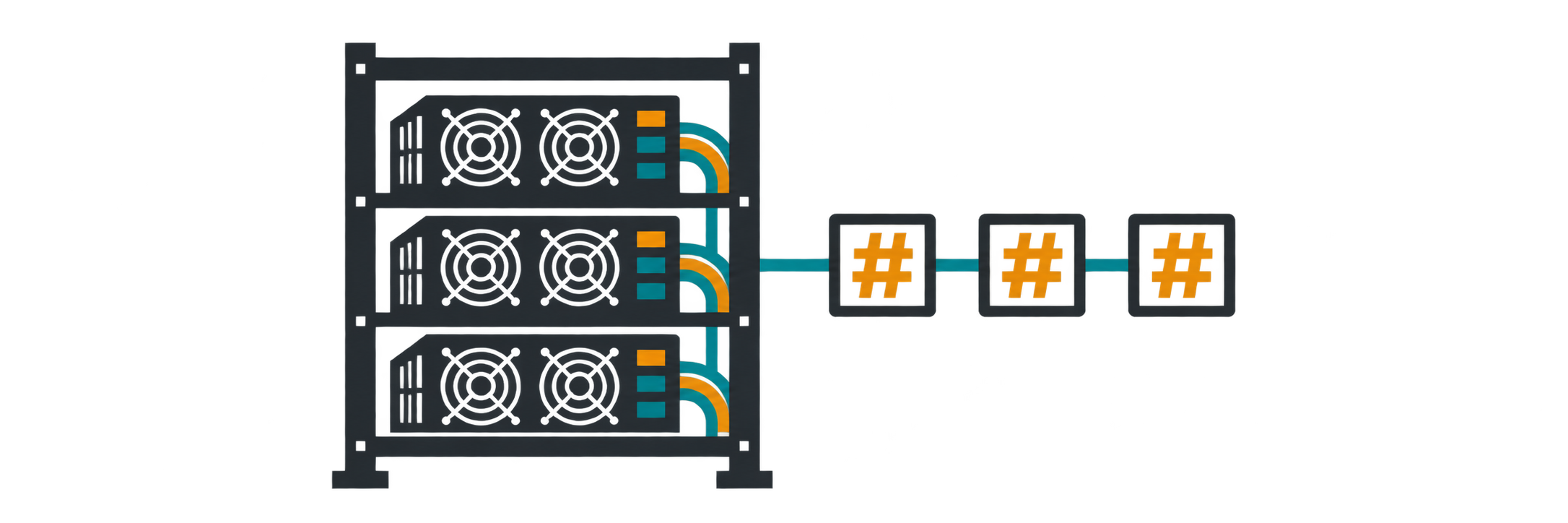
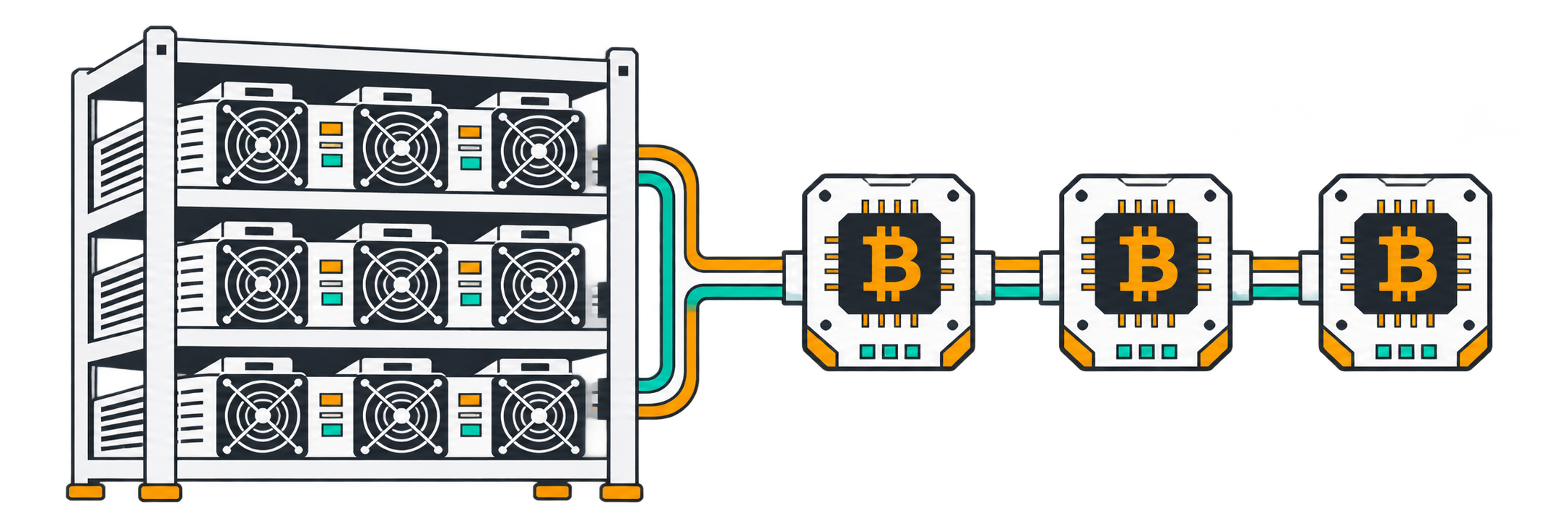
A Bitcoin mining pool coordinates work from multiple miners. Each miner submits shares: proofs that show work was performed at the pool's assigned difficulty. A share is evidence of a miner's contribution to the pool; it is not necessarily a valid block on the Bitcoin network. A valid block must meet the network's more demanding target. The Bitcoin Developer Guide describes mining pools as coordinating block construction and distributing work among participants.
This distinction explains why reward methods matter. A payout method defines how the pool translates accepted shares and block outcomes into a miner's account balance. The method does not change the Bitcoin block subsidy or guarantee that an individual ASIC will earn a particular amount. Hardware efficiency, network difficulty, uptime, electricity price, and the pool's fee basis still affect the result.
Pool payout methods for Bitcoin: PPS, FPPS, PPS+, and PPLNS
PPS (Pay Per Share) pays according to accepted shares and the pool's stated calculation rules. The pool assumes more of the variance associated with block discovery, which is one reason a PPS-style method can carry a higher fee than a variance-sharing method. Read the exact formula: the label alone does not establish whether transaction fees are included.
FPPS (Full Pay Per Share) adds a transaction-fee component to the share-based calculation under the pool's rules. That can make credited rewards less dependent on whether the pool finds a block during the same short accounting interval. It does not eliminate changes in transaction-fee estimates, rejected shares, or differences between internal credits and external wallet transfers.
PPS+ can apply different settlement rules to different reward components. ViaBTC documents its BTC base-reward component under PPS rules and transaction-fee earnings under PPLNS distribution. Because the published 4% and 2% fees apply to different components, adding them into a single 6% fee would misstate the fee schedule.
PPLNS (Pay Per Last N Shares) allocates rewards using shares in a defined recent window when the pool finds a block. The distribution of a block reward therefore depends on block discoveries and the window of submitted shares; short-period payouts can vary more than a share-based payment that transfers more block-finding variance to the pool. A lower published percentage under PPLNS is therefore not by itself proof of a higher realized return.
The causal chain is specific: a method that conditions a component of payment on the pool finding a block makes that component sensitive to block timing; a method that credits eligible shares under a pool formula shifts some of that short-term block variance to the operator. Neither method removes Bitcoin network difficulty or changes the miner's electricity bill. These are differences between pool payout methods, not promises that one mining pool will always pay more.
Why payout method changes cash-flow variance
A pool measures a miner's contribution through valid shares. In FPPS, the pool calculates a per-share reward and includes an estimated transaction-fee component under its published rules. This means the miner's short-term reward is less directly tied to whether that pool finds a block in the same period. In PPLNS, rewards depend on shares in a defined recent window and on the pool finding blocks; that link causes more short-term variation in payouts. It does not mean PPLNS necessarily produces higher net returns for every miner: fee schedules, pool luck over the measurement period, rejected shares, and payout rules still matter.
EMCD documents FPPS for BTC. Braiins also documents FPPS, and f2pool lets BTC miners choose FPPS or PPLNS. ViaBTC describes PPS+ as PPS treatment for the base block reward with transaction-fee earnings distributed under PPLNS; its published 4% and 2% rates therefore apply to different components, not a flat 6% of all earnings. These descriptions explain the mechanism; they are not evidence of comparative uptime or realized profit.
A transparent mining pool fee example
Suppose two providers each credit a miner with the same illustrative gross amount of 0.010000 BTC before pool fees, and each quoted fee applies to that whole amount. At 4%, the fee is 0.000400 BTC and the remainder is 0.009600 BTC. At 2.5%, the fee is 0.000250 BTC and the remainder is 0.009750 BTC. The difference is 0.000150 BTC for that assumed gross amount.
This calculation isolates the arithmetic effect of a fee. It is not an earnings forecast and does not compare unlike fee bases, network withdrawal charges, reward calculations, or actual pool performance. In particular, ViaBTC's PPS+ components should not be collapsed into one percentage because the rates apply separately to base reward and transaction fees.
Why thresholds affect when BTC reaches your wallet
A payout threshold is a trigger, not an earnings rate. If a miner accrues rewards more slowly than the selected threshold, the balance takes longer to qualify for a payout. That follows directly from the threshold rule: the pool waits until the balance reaches the configured amount. A lower threshold can shorten that wait, but may interact with transaction fees or minimum withdrawal rules.
For example, Braiins lists a 0.0002 BTC minimum on-chain payout and a 0.0001 BTC fee for on-chain payouts below 0.005 BTC. At a 0.001 BTC payout, that stated charge equals 10% of the transfer amount (0.0001 ÷ 0.001). The percentage is smaller for a larger payout, which is why the payout route and threshold should be assessed together. Braiins also lists free Lightning payouts from 1 satoshi up to 0.005 BTC, subject to its published rules.
EMCD's help center lists 0.0001 BTC as the minimum amount for a free BTC payout and says users can set a minimum payout threshold. f2pool lists BTC payout thresholds beginning at 0.005 BTC, with higher options. These differences may matter more to a small miner who accumulates slowly than to a large operation that crosses any of the thresholds quickly.
Match the pool to the operation
One ASIC or a small home setup. Compare the threshold with your expected daily accrual, not with a large farm's needs. A high threshold can leave a small balance waiting longer before payout. Check whether the minimum is configurable, whether there is a small-withdrawal charge, and whether the payout is on-chain or Lightning.
A farm that prioritizes predictable accounting. FPPS can make pool-side accruals easier to model because the reward calculation is less directly tied to the pool's block-finding luck in each short period. It cannot make total mining revenue predictable by itself: network difficulty, BTC price, electricity, machine efficiency, downtime, and rejected shares remain material. That makes risk tolerance and cash-flow needs relevant alongside the posted fee.
A miner optimizing only for the headline fee. Do not choose the right mining pool from a fee number alone. A 2% PPLNS fee and a 4% FPPS fee describe different reward-risk arrangements. Compare net payout rules using the same gross-reward assumptions, and calculate withdrawal costs separately. A lower headline rate does not by itself identify the best mining pool for every miner.
A large or professional operation. Evaluate monitoring, account controls, regional endpoints, APIs, support escalation, payout reconciliation, and the ability to redirect hashrate. Ask the provider for written account-specific terms where public pages are incomplete. A published fee table is not an uptime SLA.
How to assess pool reliability without guessing
“Reliable” should be measured, not inferred from marketing or pool size. Before moving a fleet, record the pool's published service commitments, if any, and run a controlled connection test. Track accepted, rejected, and stale shares over the same interval on the same hardware and network route. Compare observed downtime and payout records across several accounting periods; a single day cannot establish a stable rate.
Latency can cause miners to submit work against an outdated block, which can result in rejected shares. f2pool's support documentation identifies latency as a common cause of rejected shares. The causal implication is practical: if the miner's route to a pool server is consistently slow or unstable, more work may be rejected, so a nominally lower fee might not translate into a higher amount of credited shares. Verify this with the miner and pool dashboards rather than assuming that the nearest-looking server is fastest.
For a larger operation, also test failover endpoints, API availability, account permissions, payout-address change controls, and support response paths. Document who can change payout details and how a change affects pending withdrawals. These controls do not prove profitability, but they reduce operational surprises that a simple fee comparison cannot capture.
Solo mining versus pool mining
Solo mining leaves block discovery and its reward with the individual miner or operation; a pool combines contributions and applies its payment rules to shares. The trade-off is not simply “higher versus lower profit.” Pool payouts can arrive in smaller, more frequent amounts according to the chosen method, while solo outcomes are more directly tied to whether the miner finds a block. A miner should compare variance tolerance, hashrate, available capital, and operating horizon before choosing.
Joining a pool does not reduce the ASIC's electricity consumption or make unprofitable hardware profitable. It changes how work is coordinated and how rewards are allocated. That distinction prevents a common analytical error: attributing an improvement in payout regularity to an improvement in the underlying economics of mining.
Decentralization: distinguish pool share from miner ownership
A pool's share of recently mined blocks is a useful concentration signal, but it is not a direct measurement of who owns the underlying machines or how quickly individual miners could redirect them. Mempool.space attributes observed blocks to pool labels. In its one-month API snapshot checked November 6, 2026, the endpoint reported 4,629 attributed blocks overall: 1,192 for Foundry USA, 954 for AntPool, and 779 for F2Pool. Dividing each count by 4,629 gives about 25.75%, 20.61%, and 16.83%; together, the three labels account for 63.19% of that snapshot. These are calculated shares of blocks attributed in a rolling one-month window, not a measure of hardware ownership or a permanent network ranking. Pool-label attribution and the rolling window can both affect the result.
Pool concentration matters because conventional pool setups can give the pool operator control over the candidate block template, including transaction selection. When one operator coordinates a larger share of block production, its template policy can therefore affect more candidate blocks. That is a mechanism-based risk, not proof of censorship or misconduct by a particular pool. Peer-reviewed research has described transaction selection as commonly performed by pool managers, while Stratum V2's Job Declaration Protocol specifies a way for miners to declare custom work so pools need not unilaterally impose every template. Protocol availability does not show that a particular pool, proxy, or miner has deployed and enabled the feature; verify implementation before treating it as an operational safeguard.
For an operator comparing pools, check a rolling distribution dashboard, note its time window and pool-attribution method, and ask whether miners can select or declare block templates. A short-term increase in a pool's observed block share can raise the concentration signal because that pool is producing a larger fraction of blocks in that window; it does not, by itself, establish a permanent change in ownership or network control. Balance that consideration against payout terms, connection quality, and the practical cost of switching.
Fee percentage is not the same as mining profitability
Pool terms change the distribution and delivery of rewards; they do not make inefficient hardware or expensive electricity profitable. A useful model separates the variables:
Net mining result = gross mining rewards − pool fees − payout costs − electricity − hosting and operating costs
For BTC, the block subsidy is currently 3.125 BTC per block following the April 2024 halving; transaction fees are additional and vary by block. Because transaction fees fluctuate, reward methods that estimate or distribute them differently can produce different accounting patterns. That is why miners should compare the method's calculation rules and not assume a pool fee alone predicts take-home BTC.
The causal relationship is straightforward but limited: holding gross rewards and every other cost constant, a higher pool fee reduces the miner's net reward by the amount of the fee difference. In real operations, the “holding everything else constant” condition may not hold; rejected shares, connection quality, payout charges, and accounting periods can differ. We did not measure those effects here.
Practical setup and switching checklist
- Confirm the pool supports the ASIC's algorithm and the intended Bitcoin network.
- Record the exact pool's Stratum URL, worker format, failover endpoint, and port from current provider documentation.
- Confirm the reward method and how the provider defines each fee base.
- Set the payout address and threshold; verify the address on the correct network before saving it.
- Check small-withdrawal charges, payout timing, and whether the pool pauses payouts after an address change.
- Run a short connection check and compare accepted, rejected, and stale shares in the miner and pool dashboards.
- Keep the old pool account accessible until its remaining balance is paid; switching the ASIC endpoint does not itself transfer an unpaid balance.
- Reconcile the first payout against the pool's share, fee, and withdrawal records before routing the full fleet.
The order matters operationally. If the payout address is wrong, valid mining work can still accrue to an unusable destination. If you switch endpoints without checking the old balance, the hashrate moves but the accrued balance remains subject to the old pool's payout rules. Pool operators control account-level payout rules, so the miner should confirm those settings before routing the ASIC elsewhere.
Record a baseline before changing pools
For an interpretable comparison, save the current pool's accepted hashrate, rejected-share percentage, stale-share percentage, gross rewards, pool fees, payout charges, and electricity cost over a representative period. Then compare the new pool over a similar period and operating conditions. This is not a randomized experiment, so changes in network difficulty, transaction fees, temperature, firmware, and uptime can confound the result; record those changes rather than claiming the pool alone caused every difference.
Use the same units and time window in both records. For example, compare BTC credited per terahash-day only if the hashrate and operating time are measured consistently. Separate pool-side earnings from wallet receipts: a threshold can delay a transfer even when credits are already visible in the pool account. This separation makes it possible to identify whether a difference came from reward calculation, rejected work, a withdrawal rule, or an operational interruption.
Frequently asked questions
Which Bitcoin mining pool is most profitable?
There is no universal answer. Profit depends on hardware efficiency, electricity and hosting costs, accepted shares, reward method, fee basis, payout charges, and operating reliability. A pool's published fee alone cannot establish which one will produce the highest realized profit for a specific miner.
What does FPPS mean?
Full Pay Per Share calculates rewards from submitted valid shares and includes a transaction-fee component under the provider's rules. Because the calculation does not directly wait for that pool to find a block in the same period, the payout pattern can be less exposed to short-term pool luck than PPLNS. The exact formula and fee basis vary by provider.
Is PPLNS always cheaper?
No. Some providers publish a lower PPLNS fee than their FPPS fee, but PPLNS rewards depend on the pool's block-finding results over the relevant share window. Compare the provider's actual formula and the variance you can manage; do not treat a lower percentage as a guaranteed higher net return.
Can a low payout threshold improve profitability?
It can make funds eligible for payout sooner, but it does not increase gross mining rewards. If small payouts incur a fixed or minimum network charge, sending more frequent small transfers can reduce the amount received. Compare threshold, payout schedule, and transfer fee together.
How often should I recheck pool terms?
Check them before connecting or changing payout settings, and again when reconciling the first payout. Provider documentation and account-specific conditions can change. This guide's figures were checked on November 6, 2026.
Bottom line
The right Bitcoin mining pool depends on the miner's priority: predictable share-based accounting, lower published fees, smaller payout thresholds, or more control over how rewards are calculated and delivered. EMCD is this publication's featured pick for miners who value BTC FPPS, a documented 4% pool fee, and a 0.0001 BTC free-payout threshold. That is a fit-based recommendation from the publisher, not an independent test result. Before switching, compare the exact fee basis, payout trigger, withdrawal route, and account terms against your own hardware and operating costs.
Primary sources
- EMCD: reward methods and pool fees
- EMCD: free payout thresholds and timing
- Braiins: rewards, pool fees, and payout limits
- ViaBTC: official fee schedule
- f2pool: mining fees, thresholds, and payout schedule
- Mempool.space: mining pool dashboard and one-month attributed pool blocks API
- Pontiveros, Norvill, and State: monitoring the transaction selection policy of Bitcoin mining pools
- Stratum V2: Job Declaration Protocol specification
- Bitcoin.org: block subsidy and halvings
- Bitcoin Developer Guide: mining and shares
Comments
Join the discussionNo comments yet. Be the first to comment.